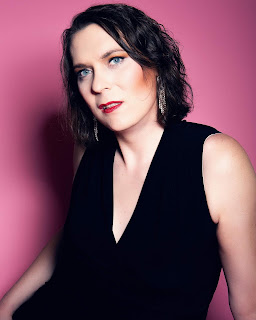
Her own experience has made bureaucracy and language more than abstract questions. At the time, Czech law did not
allow a person to change the gender marker in official documents without undergoing sterilizing surgery, while
those who did not take that route faced restrictions around names as well. Lenka chose to continue publicly as
Lenka Králová even though her official documents still carried her original male name. It was, in part, an act of
defiance, but also a way of refusing to let an administrative category dictate how she presented herself to the
world. There is something particularly compelling in the contrast between Lenka's profession, her matter-of-fact
approach to technology and everyday life, and the intensely personal questions surrounding identity, family and
belonging. Through V Tranzu, she has tried to make those questions less mysterious by giving trans people space to
speak for themselves, while showing audiences that behind the terminology and political arguments are people
living, loving, working, parenting and trying to make sense of their own lives. Her story is therefore not only
about transition, but about what happens when a private truth becomes impossible to keep private, and what courage
it takes to let that truth become visible.
Monika: Today I have invited Lenka Králová, one of the most inspirational transgender activists from the Czech
Republic. Her vlog “
V Tranzu
” provides information about transgender-related topics and includes interviews with Czech transgender women and
friends of the Czech transgender community.
Hello Lenka!
Lenka: Hello! Thank you very much for the introduction and let me greet all readers!
|
|
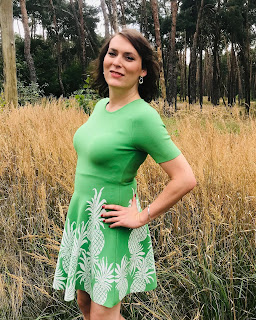
"My appearance is a huge surprise
to me. I started my transition when I was 38." |
Monika: Could you say a few words about yourself?
Lenka: I am 40 years old, I live in Prague. It took me a long time to realize my identity, so at the age of 38, I
started taking hormones. My marriage broke up after 15 years because of that, but we have a friendly relationship
with a nine-year-old son who makes me very happy.
Monika: I understand that on top of everything else, you also run your own YouTube show. Can you tell us more
about it?
Lenka: During the transition, I started filming interviews on YouTube for my show "
V Tranzu
". I have several different series there, but the most popular one is called "Trans Stories", where I invite trans
people of all ages and professions and we talk about their life journeys for about an hour.
So far, I have conducted over 30 such interviews.
The vlog helps people on several fronts - it allows people from the general public to have a close look and
understand our needs, and especially that our condition is not sexual in nature, but that we are primarily
concerned with everyday life. It helps people, who are willing to transition, to see the others who have been
through it and that there is nothing to be afraid of.
The same is for mothers of trans children. At the moment, the total number of views of all episodes reached over
700,000 views, and "V Tranzu" has become the most important source of information on transgender topics on the
Czech Internet.
Monika: And what do you do besides filming? What does your everyday life look like?
Lenka: In addition, I am also a member of the board of the Transparent Association. But activism doesn't feed me -
I work as a software developer. The break-up of the family was a great pain for me, but in the end, I managed to
find a soulmate and I have been living in a relationship with my girlfriend Nela for half a year., I met her at a
demonstration against Viktor Orbán's anti-LGBT laws in front of the Hungarian Embassy.
Monika: So we could say that it was love at first sight with Nela?
Lenka: Well, not really. For her, it was love at first sight, but at the time, I was unhappily in love with
someone else who didn't want me. I also had a prejudice against the large age (19 years) and height differences
(40 cm). But Nela didn't give up. She attended events where I performed and brought me giant bouquets, and over
time I found that I liked to spend time with her. It used to be me who courted girls and somehow I thought it
would stay that way. But for the first time in my life, someone courted me and she succeeded! Gradually, I found
myself falling in love more and more. And now we have been living together for several months and our relationship
is working out beautifully.
Monika: When I was preparing for this interview, I read a lot of articles about you online, and I noticed that
people most often ask you why you haven't "completed" your transition. Is Czech society even ready to move past
such a simplistic view of male and female?
Lenka:
I'm really quite surprised by that question. I never say I didn't complete the transition - I just say I don't
want the surgery. After all, it is not possible to say that the trans women, who voluntarily decided not to let
themselves be cut with a scalpel, did not complete anything. I live a perfectly female life from morning to
evening, everyone addresses me everywhere as a woman. I perceive myself as completing the transition with great
success. I'm happy and content with myself and that's what it's all about. The only thing that I have a little
more complicated is my sexual life, but that's purely my business.
|
|
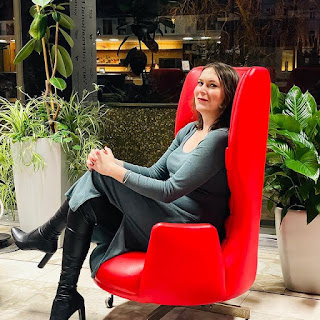
"Many trans women I know have some
expectations and are often disappointed. I just had low expectations and thanks to that I am happy now." |
I'm surprised that as of 2022, someone called it an "uncompleted transition." In our country, the society and
sexologists have long been pushing trans women to believe that without surgery they will not be real women. We are
one of the last countries in Europe that do not allow official gender recognition without surgery. To call it
"uncompleted transition" is, in my opinion, extremely toxic and degrading. As if the trans women who had not
decided to do so were somehow inferior and "uncompleted." After all, it is primarily everyday life that matters.
Each week has just over 10,000 minutes. How many of those minutes do we spend having sex? Who in everyday life
sees what we have or do not have between our legs? It is everyone's private business.
Monika: What about you personally - how do you experience body dysphoria?
Lenka: There are trans women who have severe physical dysphoria and cannot tolerate their genitals. But for
example, I had mainly social dysphoria. I hated male life. I have a completely neutral relationship with my
genitals. I am ok with living with them, it is not worth the huge risks that the surgery carries - for example,
loss of sexual sensitivity or incontinence. The only thing where it matters is sex, and my current girlfriend has
no problem with that. I would take a woman's body right away if a wizard came to me and created it for me using
magic. But that's not the case. I myself cannot perceive the surgically created organ in my head as something
other than an imitation. Although I realize that for many girls it is liberation and that they long for it - it is
just my personal feeling.
Monika: Does the fear of the health risks that surgery carries play a role too?
Lenka: I have never been seriously ill, I have never been hospitalized, I have never had any surgery. I'm so
afraid to gamble with my healthy body, especially because of something I don't care that much about. Only my
girlfriend and I see my genitals, so I definitely won't do it just because of other people. And certainly not
because of the legal requirements, I'd rather continue to function in society with the letter M and my original
name. I think that this is my big task and mission, to break those stereotypical ideas in the Czech society. In my
opinion, the biggest problem is the perception of being transgender as a problem of a sexual nature. After all,
just having to go to sexologists in our country is humiliating enough. At the same time, it is only a historical
legacy.
Monika: Many of us pay a high price for being able to be ourselves - we lose our families, friends, jobs, or
social standing. Did you pay a similar price?
Lenka: It was a bit unusual for me. I didn't lose my job or any friends because of that. My social status has even
improved significantly - I used to be just a dad who comes home after work, and now I am a well-known influencer,
and I have had countless interviews in newspapers and television stations, and I receive invitations to various
social events.
Monika: So what was the hardest thing about your coming out?
Lenka: However, what I lost was the family. I cried a lot. Most of all, I was afraid to lose my wife and it was a
legitimate fear - it was the worst moment of my transition. Her reaction was very negative and then she took it as
if her husband died. For a while, our relationship was downright hostile.
|
|
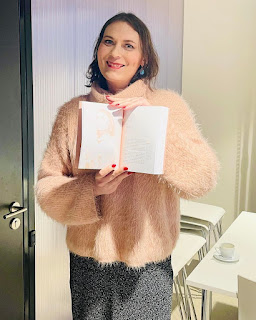
"We have always been here"
(Byli jsme tu vždycky), 2022. |
Monika: And what's your relationship like today?
Lenka: However, now it will be three years since my coming-out and our relations have already settled and have
been friendly. Sometimes we even call each other. We have a son together (he is now 9 years old) and we are in
contact several times a week. But my son reacted to my coming out very well. We have an amazing relationship and
he is such a great ally of mine. He calls me "Daddy", but otherwise uses feminine words to address me.
Monika: You look absolutely amazing, so this question may not really apply to you - they say we're often judged
by whether we "pass" or not. Even though cosmetic procedures sometimes help with that, we probably can't avoid
people's judgment altogether. How do you deal with that?
Lenka: Well, really, my appearance is a huge surprise to me. I started my transition when I was 38 (I'll be 41
soon). I was very bearded and hairy. I was convinced that I had started the transition too late, and I will never
pass at first sight. But I didn't care. I went into it with that in my mind. I just wanted to live a woman's life
and I didn't care that everyone would turn around and stare at me.
Monika: And how did your appearance change once you started hormone therapy?
Lenka: Then I started hormonal therapy and I'm probably very lucky with genes, because I didn't have to have any
plastic surgery, and not only do I look feminine, but I see myself as really beautiful. I am infinitely grateful
that even though I started transitioning just before I turned forty, I can still enjoy the time when I am a mature
woman and I am myself. I still can't believe it completely. Thanks to the fact that my appearance exceeded my
expectations by about 1000%, I am completely 100% satisfied with my transition and I would not change anything -
this is probably not typical either. Many trans women I know have some expectations and are often disappointed. I
just had low expectations and thanks to that I am happy now. This may be my recipe - not having high expectations
and then one can only be pleasantly surprised.
Monika: Do you remember the first transgender woman you ever saw on TV?
Lenka: When I was growing up, the M.A.S.H series was broadcast on television every day, featuring the character
Klinger, a soldier who disguised himself as a woman to be considered a fool in order to be discharged from the
army. Then I don't remember anything for a long time until the film Danish Girl came and the Czech series Most.
But in these cases, trans characters were played by a cis actor or a cis actress.
Monika: And once you started realizing your own identity, did you follow any trans YouTubers?
Lenka: When I started to discover my identity, I purposefully searched for this topic and I saw more of those
trans women on YouTube, and I watched mainly American channels, I don't remember which one was the first. Tereza
Španihelová (Tores Gorgeous) was visible among the Czech YouTubers at that time, however, she recently deleted her
videos and publicly expressed hate on Instagram for the girls who decided not to undergo surgery. That's the end
for me and perhaps all the trans girls I know, and she is rather for laughs to people now.
END OF PART 1

Main photo: @
annahrabakova
All photos: courtesy of Lenka Králová.
© 2022 - Monika Kowalska
No comments:
Post a Comment