
Brina Healy is a visionary film director and photographer hailing from Boston, Massachusetts. Brina’s journey in the world of cinema began back in 1978 when, as a student in Kansas, she directed her first short film while juggling her role as a yearbook photographer. Her early career included working behind the scenes on TV in Boston, where she appeared on beloved children’s shows like Major Mudd and Boomtown. She later made an appearance in Happy Madison’s Grown Ups and gained recognition for her cult classic 2012 spoof film, Transsexuals from Space.
Beyond the camera, Brina is also a second-degree black belt in Shotokan karate, showcasing her diverse talents and relentless spirit. With decades of experience in the film industry, Brina brings a unique perspective to her work, merging creativity with a keen understanding of the challenges faced by transgender individuals in entertainment. Her passion for storytelling and commitment to inclusivity shines through in her projects, particularly in her desire to elevate transgender narratives and portray authentic experiences. Join us as we dive into Brina’s fascinating career, exploring her inspirations, insights into the industry, and thoughts on the representation of transgender stories in film.
Monika: Brina, it’s such a pleasure to have you with us today. Thank you for joining me!
Brina: Monika, thank you for the honor and the respect of being featured in your publication. Your interest in my career truly means a lot, and I’m happy to speak with someone who has walked a similar path. That makes us sisters, doesn’t it?
Monika: It clearly does! With talents spanning producing, modeling, and photography, is there one label you’d choose above the rest, or do you see yourself as something else entirely?
Brina: I’d classify myself as a “Creative” (want fries with that burger?) type, so I enjoy spending time in all of these areas. “Paste-up” work is relatively dead in the digital age. Film production is something that sways me greatly, although it’s difficult to make a legitimate living at it as a career move. Basically, many areas that involve the creative process do not require state or federal licensing, so those markets naturally get flooded. I’ve been involved with imagery my entire life and consider photography and large format my first love. One of the most exciting job positions I held involved trafficking building “wraps” for Broadway, Madison Square Garden, and the World Trade Center Concourse.
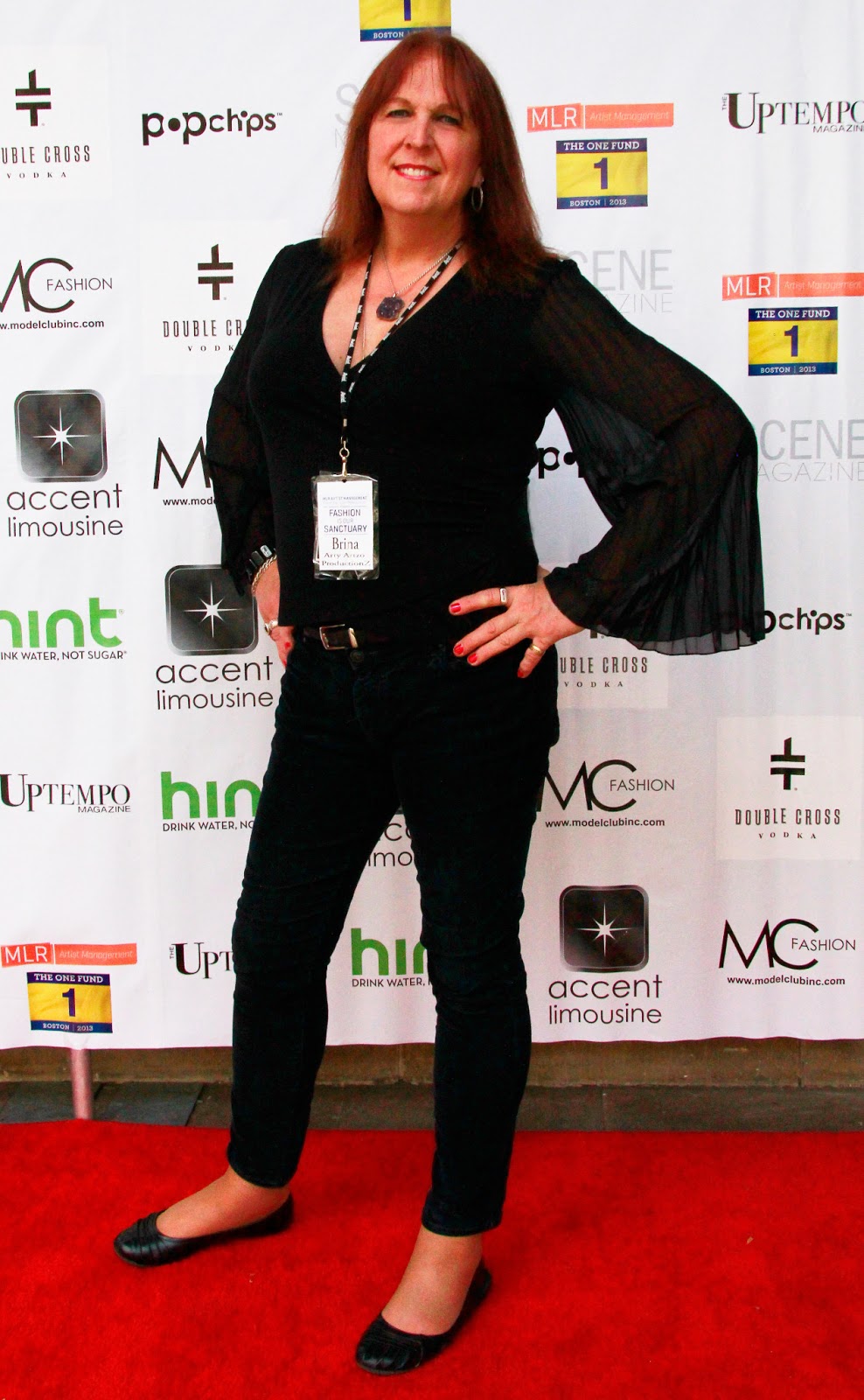
|
| On the Red Carpet. |
Monika: That sounds like quite a sight to see your work displayed on such a massive scale. Did that experience ever pull you toward modeling yourself?
Brina: Seeing the files you’ve worked on in an exciting city scene forty feet tall is a real rush. Being trans, but older, I find very limited opportunities in modeling. I began my modeling career as a male model for the department store chain “Jordan Marsh,” with runway and print work. I embraced being behind the camera more, so my early modeling career lasted only several years and was not elaborate. I do continue to enjoy the attention and can still rock the runway! Creativity has always been my constant, no matter the medium. It’s not just what I do, it’s who I am.
Monika: Film clearly runs deep for you. Which directors or movements have had the strongest pull on your creative vision?
Brina: I’ve always enjoyed offbeat, alternative, and cult movies and producers, and I derive a lot of inspiration from them. The Mel Brookses, Tim Burtons, Roger Cormans, Quentin Tarantinos, and Wes Andersons of the film world give us fascinating work. Also, more mainstream directors like Steven Spielberg, Michael Bay, and Robert Zemeckis bring us elaborate production value and expand on a world of both fact and fantasy. I love the way these directors create entire universes that draw the audience in, whether through humor, drama, or spectacle. Their storytelling instincts and visual flair continue to push me in my own creative pursuits.
Monika: You started out in front of the camera as a child, appearing in kids’ shows. What was that like, and how did it shape your creative path?
Brina: Those appearances were more of a childhood rite than a true passion for acting. They did, however, give me my first taste of what an interesting world a video studio can be, and sparked the curiosity that still fascinates me today.
Monika: Did that early curiosity eventually carry you into more serious auditions?
Brina: Currently, I’m auditioning for a range of roles that pique my creative interest as well as feed my ego. I’ve had the amazing opportunity to either appear in or crew on nearly fifty feature and indie films and TV movies and episodes.

|
| A screengrab from “That’s My Boy” (Adam Sandler film). |
Monika: Speaking of studio work, has staying non-union shaped the kinds of roles that come your way?
Brina: I’m still non-union, so my opportunities for significant work in studio film projects are limited, but I get more indie work that way. Actors not cast in principal studio roles are always hoping their lines appear in the final edit. My lines in That’s My Boy (a Happy Madison/Adam Sandler film) were cut, although my character does appear in the film in another scene, so that was still promising. Such are the conditions of studio work. Still, each project is a learning experience that adds something new to my artistic growth. I remain committed to refining my craft and embracing whatever roles come my way.
Monika: You’ve worked on both indie and studio productions. What stands out as the biggest difference between the two, and do you lean toward one?
Brina: There’s a huge difference between indie films and studio films. They both have their minuses and pluses. You have more input on an indie and can go “off-book” as an actor more often. Studio films have the perk of working on a major production with industry notables, a greater range of different historical settings, elaborate costuming and makeup, and a more grandiose production value.
Monika: Have any encounters with well-known actors on set stuck with you over the years?
Brina: Meeting the starring principals can be a thrill as well. I was doing casting work on the film Moonrise Kingdom and spoke with actor Bill Murray on set. I approached him and greeted him as “Bunny Breckenridge” from his role in Ed Wood. He responded to me in character and stated that he was “not personally transsexual, but I do have many transsexual friends, and I see that you’re transsexual.”
Monika: Have you crossed paths with any stars who are no longer with us?
Brina: I’ve also met stars who are no longer with us: Chris Farley on the set of Wayne’s World, Lloyd Bridges on the set of Blown Away, and Robert Urich from Spenser: For Hire. Both film levels are enjoyable for their own reasons and contrasts. Working independently allows for more creative risk-taking, while studio sets offer the magic of large-scale collaboration. I appreciate both worlds and value the lessons and friendships that come from each experience.
Monika: Your background spans both film and art education. How did your formal training shape your approach to photography and visual storytelling?
Brina: My formal art education began in the ’70s at the Massachusetts College of Art in Boston, where I audited photography classes and learned imaging basics. At the time, I was working as a staff photographer for a college yearbook manufacturer. They noticed my natural ability for portraiture and really helped me develop it. From there, I began traveling the continent and the Hawaiian Islands doing freelance, magazine, and photojournalistic work. I was a staff photographer for The Patriot Ledger (Boston South) and a stringer for The Boston Globe.

|
| “Transsexuals From Space” (YouTube) |
Monika: How have those early assignments continued to shape the way you approach your craft today?
Brina: All of these assignments helped me hone my eye and develop my personal style. I continue to enjoy a journalistic approach to my shooting and still receive favorable reviews of my work. My education laid a solid foundation that continues to influence my creative decisions today. It also taught me the importance of capturing authentic moments that tell a compelling story.
Monika: How do you feel about the way transgender stories and actors have been represented on screen so far? Is the industry moving toward more authentic casting?
Brina: I’ll be pleased when trans actors are routinely cast in trans roles. For example, Felicity Huffman performed an amazing role in TransAmerica, but that role really should have gone to an actual trans actor. Other films have been correctly cast, such as Cillian Murphy’s role in Breakfast on Pluto.
Monika: Are there examples where you feel the casting missed the mark, even with good intentions?
Brina: Priscilla: Queen of the Desert was a funny romp with straight men portraying drag performers. I enjoyed the casting in that film. I’ve been turned down to play female roles, and it’s unfair and upsetting, as my female persona is quite strong and well-constructed.
Monika: Given that double standard, has your own film work given you the room to play those roles yourself?
Brina: Although I’m “out” in my film career, I feel I can portray a natal female well. So much for double standards! Actually, the only role I’ve played as a transsexual was in my own film, Transsexuals from Space. I believe greater inclusion and respect for trans actors will enrich storytelling and authenticity in film. There’s still a long way to go, but I’m hopeful the industry will continue to evolve positively.
Monika: Some critics argue the industry offers limited opportunities for women between forty and sixty, and even less for trans actresses hoping to reach a wider audience. Does that match what you’ve seen in your own career?
Brina: My experience in film is that although male roles span every age bracket, females between forty and sixty seem to have mostly disappeared from major roles, except for the likes of Susan Sarandon and Meryl Streep. Younger females, from about twenty to thirty-five years old, get the majority of female film work, then roles tend to jump to seniors sixty and up. That’s the continuing state of filmmaking.
The film industry has long been dominated by male studio moguls who have promoted men, that’s what men have always done. This age gap and gender bias make it especially challenging for trans women to find substantial roles as well. Until the industry embraces more diverse and realistic representations, many talented actors will remain overlooked.

|
| “Transsexuals From Space” (YouTube) |
Monika: Do you weave any autobiographical elements into your films? How much of your own experience finds its way into the characters you portray?
Brina: Ha! I do. In my film Transsexuals from Space, I get to fully embrace my natural trans nature. In the indie film 10, my role was an apparition risen from the dead who killed off several of the cast, so I was given the opportunity to go “off-book” and express my darker side. I find that blending personal experience with creative storytelling helps bring authenticity to my work. It also allows me to explore different facets of my identity in a way that’s both liberating and meaningful.
Monika: What motivated you to produce and direct Transsexuals From Space in 2012? Was there a particular message you hoped to convey?
Brina: It’s tiring having people laugh at trans people, so I wanted them to laugh with us. Trans people are basically the same boring creatures as everyone else, so why the hate? Our cast and crew include lesbians, transsexuals, cross-dressers, transgender people, and straights. We wanted to represent a full spectrum of players. Being involved in local film work on a weekly basis, it felt like the right time for me to reach out and create my own opus. The film was my way of reclaiming our narrative with humor and honesty. I hope it encourages audiences to see us beyond stereotypes and embrace our shared humanity.
Monika: Your film is described as transgender troublemakers from the planet Transmotivia traveling through space, pushy, prissy, and pugnacious to everyone they meet, then getting more than they bargained for once they reach Earth. It sounds like a kind of transgender Star Wars with a twist. How would you describe the tone and inspiration behind it?
Brina: Actually, it’s a bit more like The Rocky Horror Picture Show. That film is nearly forty years old and it’s definitely time for some new laughs. Our film shares the concept of “movie kits” and audience participation in a true cult style. I wouldn’t mind sharing the bill with Rocky from time to time. The spirit of fun and irreverence drives the whole project, and we aimed to create something that both entertains and challenges traditional ideas. It’s about celebrating difference with humor, rather than hiding from it.
END OF PART 1

All the photos: courtesy of Brina Healy.
© 2026 - Monika Kowalska

No comments:
Post a Comment