Monika: Today let me present a charismatic woman from Germany. Christin Sophie Löhner is a German author, politician, activist and feminist, blogger, speaker on transgender topics, and expert in web development and server administration. In 2019 she published her autobiography „trans(*)parent: Wie eine Normvariante der Natur ihren Weg findet”. Hello Christin!
Christin: Heya Monika! Thanks for being with you. It is a pleasure for me to answer all your questions!
Monika: Did I miss anything in my introduction? You are a woman of many talents. :)
Christin: Haha, thanks! I'm asked from time to time how many hours my days actually have. My main daily business - besides my full-time job of course - is all about my own German-wide organization for self helping groups and peer support.
Monika: Your main profession seems to be web development. You can boast an impressive number of IT projects, being an expert in web development with HTML, CSS, PHP, MySQL, and JavaScript and in Linux server systems. How did you get interested in web development?
Christin: The web development and the Linux server administration is, what we call in german "my hobbyhorse", "Mein Steckenpferd". I started to work with web development in 1998. Within three weeks - I was unemployed at that time - I learned PHP only by try and error and developed the APBoard, which became very popular at that time.
Web development always comes with a bit of server administration and so I learned how to install a web server, a database server or a mail server at the same time. It didn't take long until I said goodbye to Windows on my PC and from then on used Linux only. And so I now look back on almost 25 years of professional experience in web development and server administration.
Monika: In your profession, women are so underrepresented. Do you find it difficult to compete with men?
Christin: In fact, there are already many women involved in web development. In my development team at work, we are currently two women out of a total of six team members. I came out as a transgender woman on my second day at work after I started working there. I was immediately and without ifs and buts recognized and respected as a woman who does good work. In fact, I find it very easy - for me - to assert myself in this environment, as everyone values my advice and expertise in this area.
|
"It is important that we
are loud and visible." |
Monika: You can boast many achievements in your transgender activism. Could you elaborate more on some of your initiatives?
Christin: I simply try to help and support as much as possible. I try to do this, of course, with my organization, VDGE e.V., but also in politics. I just try to be as active as possible on as many fronts as possible. I'm sure you know what the TERFs say about us? Trans women are not women, they say. There are no women with penises, and so on. I recently started an initiative to counter that, and it's doing quite well. You can find more info via vdge.org.
Monika: Of course, I know TERF ladies - trans-exclusionary radical feminists. According to them, we are not women. The problem is that they are quite vocal and have many well-known members, including J. K. Rowling, author of the well-known Harry Potter series...
Christin: Alice Schwarzer and her magazine "EMMA", Eva Engelken from BÜNDNIS 90/DIE GRÜNEN, Monika Barz, Terre Des Femmes e.V., Fairplay für Frauen e.V., and many many more... It's a shame that the Harry Potter author in particular is so trans-exclusionary and spreads such brutal hate and agitation. Especially because, of course, she also has a very loud voice that many people listen to.
Monika: What are the main objectives of VDGE?
Christin: The VDGE e.V. is a Germany-wide association of people with body and gender dysphoria and provides self-help and peer counseling throughout the German-speaking world. For this purpose, we establish self-help groups and peer contact points in every major city. We hold lectures and seminars at schools, universities, and social institutions and thus do prevention work against bullying and discrimination and educate about the topic of transsexuality. We also try to be as visible as possible by being in the media as often as possible (TV, newspapers, radio).
Monika: For the last years you have been very active in politics. Being a member of the Alliance for Human Rights, Animal and Nature Conservation you ran for the mayor of Konstanz (a city on Lake Constance (Bodensee), in southern Germany) in 2019-2020. Do you think that we transgender women can make a difference in politics?
Christin: Of course! Does it make a difference if someone is trans or not? Of course, transgender people can also achieve something in politics. I actually have a lot of supporters. It is important that we are loud and visible. And if we can even be loud and visible in the German Bundestag, that's all the better. There are so many building sites in politics that affect us, not to mention the German Transgender Act.
Monika: Are you still active in politics?
Christin: Yes, I am still very active in politics. I'm on the federal board of the "mut" party, as well as the spokesperson for queer issues, so I try to advocate for us and our community as well. Let's wait and see if I candidate as the mayor of Constance in around seven years again.
Monika: You ran for the mayor of Constance before, unfortunately, you did not win. What changes would you bring to your city if you had won the elections?
Christin: At that time, I withdrew my candidacy because a far more experienced politician entered the stage with almost exactly the same election program as I had. It no longer made sense for me to take votes away from this politician. Unfortunately, he didn't win either. If I had continued to run and even won, I would of course have ensured that a much more colorful and diverse politics would have taken hold in Constance. But that's not all, of course. I stand for very climate-friendly and very left-wing politics.

|
"I met my partner shortly
after my coming out in a
support group in Austria." |
Monika: Last year Tessa Ganserer and Nyke Slawik, both of the Greens party, were the first transgender women to win a parliamentary seat in Germany. Does it symbolize the change in the perception of transgender women in German society?
Christin: I hope so very much! It was about time that a trans woman finally got into the Bundestag and stirred up politics there. I know Tessa personally and she is a very dear, nice and above all engaged woman. Nyke also seems to me to be very committed. I think that both of them will achieve a lot, especially concerning the Self-ID or anti-discrimination.
Monika: At the same time, I hear some complaints about some aspects of the German national health system. Although it is one of the best in the world, transgender women still face many problems with "Alltagstest” (a real-life test during which transgender women are supposed to “experience” life in their gender) and a lack of experienced GRS and FFS surgeons...
Christin: Oh, yes! The darn "Alltagstest" is such an unbelievably contemptuous test. You have to imagine that an older, let's say around 50 years old, with beard shadow and a gait like a Texan cowboy, suddenly has to put on a dress, put on makeup and walk around in public like that for a year to even get a right to the hormones in the first place! This is absolutely unacceptable and only causes much more suffering in which this person is then socially excluded, laughed at, and maybe even attacked. This test must absolutely be abolished. There are enough surgeons for gender reassignment surgery in Germany, very good ones. But because of the face feminizing operations, there is still a need to catch up.
Monika: We all pay the highest price for the fulfillment of our dreams to be ourselves. As a result, we lose our families, friends, jobs, and social positions. Did you pay such a high price as well? What was the hardest thing about your coming out?
Christin: I have been very lucky so far. Although I didn't have my real, final coming out until I was 43, my parents, siblings, and all other relatives have been absolutely understanding and supportive of everything right away. I have also not lost a single friend. My coming out was really very easy, although I really went from 0 to 100%. On my last day in the male role - on my first day at my new job - I obviously looked like a guy. And the next day, my second day at work, straight into wig, makeup, female blouse. And since then, only completely in the female role, without exception.
I can imagine very well that it was difficult for my parents and also for my employer. But they all pulled together and supported me fully. In fact, there were no problems or difficult situations with my coming out and afterwards. Of course, now and then there are people who stare at me or whisper. But that's all.
Monika: Are you satisfied with the effects of the hormone treatment?
Christin: You know, Monika, I'm not a young girl anymore. I came out at the age of 43. The hormone treatment started when I was 44. This year I will be 50 years old. At my age, you can't expect so much when it comes to hormones. Besides, every body reacts differently to hormones. I am at least not dead unhappy about the effect on me. I have always had very good hair growth and very little beard growth.
Monika: We are said to be prisoners of passing or non-passing syndrome. Although cosmetic surgeries help to overcome it, we will always be judged accordingly. How can we cope with this?
Christin: Of course, we are judged by that because we judge ourselves by that. It is said that a penis does not make a man or that a woman is and has always been a woman, even if she should have a penis. Nevertheless, we judge ourselves most by how well we fit into the gender role in terms of appearance (passing). Every transgender person is unhappy and falls into the deepest depression if the hormones do not work properly (for example breast growth or deep voice). A transgender woman desperately wants to look as feminine as possible, that is, to fit into the role model as well as possible. As long as we ourselves do not separate from these role models and clichés, the general public will not either.

|
"I don't have a real, embodied role model.
For me, we are all role models." |
You can't force anything. If the body does not want to accept the hormones, then it is just so and then you have to live with it. In the same way, you don't have to walk around in a dress or have long hair all the time. These are clichés that we finally have to get rid of. A man is a man when he says that about himself. No matter if he has a higher voice or a vulva.
Monika: Do you remember the first time you saw a transgender woman on TV or met anyone transgender in person?
Christin: Oh yes. That was in early 2007 when I first learned about this issue in the first place and thus realized what was actually my problem, which I've been struggling with since early childhood. That was when I was actually coming out. I met so many people and talked to so many people at that time. Unfortunately, I can no longer say who was the first.
Monika: Are there any transgender role models that you follow or followed?
Christin: I don't have a real, embodied role model. For me, we are all role models. All of us transgender people have such a hard fate to bear, the ordeal until coming out and beyond, we are constantly ostracized, discriminated against, attacked, laughed at, beaten up or even murdered. And yet each and every one of us manages to defy it all and go our own way. We are all role models.
Monika: Do you like fashion? What kind of outfits do you usually wear? Any special fashion designs, colors, or trends?
Christin: Attention cliché! Hey, I'm a woman, of course, I like fashion! Haha, I love great clothes and bright colors! But most of all I like to wear casual, very normal and boring. There was a time at the very beginning after my coming out, when I absolutely had to wear the shortest dresses, petticoats, and rockabilly dresses. That's another cliché that transgender women in particular fall into after coming out. We want to be as feminine as possible and exaggerate it. Hey ladies, take it easy!
Monika: By the way, do you like being complimented on your looks?
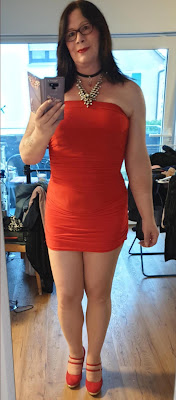
Christin: And the next cliché. What woman doesn't like that? Just last night it happened to me again. A guy told me that I looked fantastic in the red dress in my profile picture on Facebook and that it suited me very well. Of course, something like that goes down like a ton of bricks. I love getting compliments on my looks or my clothes. Of course. You not?
Monika: I do but I never know whether I really look good or someone tries to be nice to me. When I transitioned I started exploring fashion with the enthusiasm of a teenage girl and I would never go out without my make-up. Yes, I was hungry for compliments. Nowadays, being a mature woman... I am still hungry for compliments! Haha! However, I have not been too successful with dating.
Christin: The search for a partner, oh yes. That is such a problem in itself. Most people have a lot of prejudices about us. A guy who would see a pretty trans girl at the bar without knowing if she's trans would definitely hit on her and flirt with her, want to get into bed with her. But once he knows she's trans, no matter how pretty she is, he suddenly finds it gross and doesn't want to. Yes, that's another one of those clichés, but let's face it, that's how it is 99.9% of the time. I met my partner shortly after my coming out in a support group in Austria. Michelle is also trans herself. And it works wonderfully. We are mega happy.
Monika: What inspired you to write „trans(*)parent: Wie eine Normvariante der Natur ihren Weg findet” (2019)?
Christin: Ohh, there were very many reasons to write this book. I have experienced very, very much in my life. Especially pretty bad things because of my transsexuality, respectively because of my behavior, my way, and my appearance. I was brutally raped several times, was very badly addicted to drugs, and prostituted myself for many years.
My school years were very bad because I was bullied a lot and of course, I couldn't cope with myself. In the end, however, I survived despite everything and went my way. There are so many tips and information in this book and every person can get so much out of it. And that was the main reason: to help and encourage as many people as possible.
Monika: Which aspects of your transition covered in the book could be interesting for other transgender women?
Christin: Well, I tell every single aspect in detail. I tell how I found and experienced my first therapist, why I went to another therapist, how I got the hormones, how I did my first name and marital status change, how and when I then applied for gender reassignment surgery, breast reconstruction, and on and on. Of course, policies, guidelines, and laws change over time. Nevertheless, every person who is affected by these topics can draw a lot of helpful information from them.
Monika: What would you recommend to all transgender women that are afraid of transition?
Christin: I know that this step is very scary. Social exclusion, discrimination, sometimes even hatred. But we are many and we are strong. We all stand by you and support you. You will find so many new friends. And you are finally you! It is worth it! Contact counseling centers. Go to a support group. Get help!
Monika: My pen friend Gina Grahame wrote to me once that we should not limit our potential because of how we were born or by what we see other transgender people doing. Our dreams should not end on an operating table; that’s where they begin. Do you agree with this?
Christin: Oh yes! Absolutely! However, there are many people who believe that after the operation everything will be better or life will change. Unfortunately, I have to tell these people: No. Your life will not change! You will have the same debts. You will have the same problems. You will have the same life as before! But you are finally you and that is what counts. Don't do the surgery because you think that everything will be different and better! Do the surgery so that your soul will be better! And then? Do not stand still. Fight with us for our rights and stand up for who and what you are!
Monika: Christin, it was a pleasure to interview you. Thanks a lot!
Christin: It was a pleasure for me too! Thanks a lot for this chance!
All the photos: courtesy of Christin Sophie Löhner.
© 2022 - Monika Kowalska
Some documentaries with Christin Sophie Löhner:


