
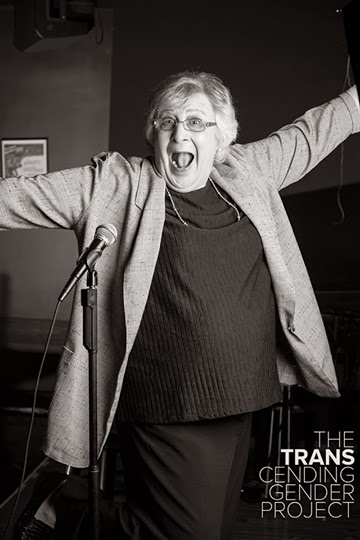
Julia Scotti is an American comedian, former teacher, speaker, and transgender woman who was born and raised in New Jersey. She began her stand-up comedy career in 1980, performing under the name Rick Scotti, and became part of the vibrant New York comedy scene alongside such future stars as Jerry Seinfeld, Paul Reiser, and Eddie Murphy. During her early career, she toured throughout the United States and Canada, headlined comedy clubs, and opened for musical acts including Lou Rawls, Chicago, and Frankie Valli and the Four Seasons. Her experience in the entertainment industry gave her a solid foundation in comedy and helped her develop the distinctive storytelling style that would later become a hallmark of her performances. In 2000, Julia stepped away from stand-up comedy and began a new chapter in her life. She pursued a career in education, working as a sixth-grade language arts teacher, and also spent time working as a stockbroker. These professional experiences gave her a different perspective on life outside the entertainment industry. Meanwhile, she continued her personal journey toward living openly as the woman she knew herself to be.
In 2011, Julia returned to stand-up comedy under her own name, Julia Scotti. Her comeback marked an important turning point, allowing her to combine her long experience as a performer with the perspective she had gained during her years away from the stage. She embraced her identity as a transgender woman while continuing to focus on what she loved most: making people laugh. Her comedy draws on personal experiences, observations about everyday life, and the absurdities of human behaviour, allowing her to connect with audiences through humour and honesty. In 2013, The Advocate named her one of the five hottest transgender comedians in the country, highlighting her growing visibility as a performer. Her return has demonstrated that it is possible to begin a new professional chapter later in life and that personal authenticity could become a source of strength on stage. Julia Scotti continues to develop her career as a comedian, bringing her distinctive voice, life experience, and sharp sense of humour to audiences.
Monika: Julia, welcome! It’s a pleasure to have you with us today.
Julia: Hello Monika! Thanks for having me!

|
| Julia Scotti Standup Comedy. Source: YouTube. |
Monika: Could you tell us a little about yourself?
Julia: (laughing) I try to say as few words about myself as possible, but here it goes! I was born and raised in New Jersey. My parents divorced when I was six years old, and so my older sister and I had to pretty much fend for ourselves. I recently went back to the apartment building we grew up in, and judging from the looks of it, we must have been poor too. So… poverty, alcoholic father, single mother with schizophrenia, Catholic guilt, and being a latchkey kid; comedy was a natural for me!
Monika: Does your stand-up include many transgender jokes?
Julia: All of my comedy is based in truth. Being transgender is part of my life, so yes, it does. Even though it is a big part of my life, it is a small part of what I do on stage, and only when I feel like going in that direction. In order to reach mainstream audiences, I need to focus on those things to which they can relate. Plus, I prefer to think of myself as a comedian who happens to be transgender as opposed to being known as a transgender comedian. There’s a big difference.
Monika: Your career took off in “Hell’s Kitchen” in 1980, when you joined the New York City comedy scene alongside such contemporaries as Jerry Seinfeld, Paul Reiser, and Eddie Murphy. What was that time like?
Julia: If I had known that they were all going to be that famous, I would have taken more pictures with them! The truth is, none of us knew that we were witnessing (and being a part of) the birth of a worldwide comedy explosion. New York, Boston, San Francisco, and Los Angeles were the breeding grounds for so much talent back then. Most of the household names in comedy today were just journeymen (and women) comics, bouncing around the major cities from club to club. It was a historic time, and I am so grateful to have been a small part of it. I have some fantastic memories!
Monika: Winning Showtime’s Funniest Person in America Contest for New Jersey seems to have been a turning point. How did it change your professional life?
Julia: It gave me some exposure on national television, and because it coincided with the sudden boom in comedy clubs, I was able to tour the country, working my way through the ranks from emcee to headliner. I didn’t win the competition for the country though; that, as you know, was won by Ellen DeGeneres.
Monika: Tell us more about “Julia Scotti’s Comedy Test Kitchen” and the other successful shows and performances in your career.
Julia: The Test Kitchen was an idea I had when I came back to comedy after an eleven-year absence. I wanted to recreate the atmosphere of the Original Improvisation in New York, which was where I started my career. I invited singers, dancers, and of course comedians to come by and work out new stuff, and it was a joyous time! We did it in a small upper room in a bar in Philadelphia. It was just what I needed to get my show business feet wet again. From there, I have been very blessed with good fortune. In 2012, I was the first transgender contestant (and finalist) in The Ladies of Laughter comedy competition, and I have performed at Planet Hollywood in Las Vegas and the Tropicana in Atlantic City, and have recently moved over to the Borgata Comedy Club in Atlantic City.
|
| Courtesy of Julia Scotti. |
Monika: Is there such a thing as transgender art, and what does it mean to be a transgender artist?
Julia: Those are great questions. I think that an artist of any stripe creates original art based on his or her life experiences. So a transgender person will create things that incorporate those experiences into their finished product in the same way that anyone else would. It may not be obvious in the product, but it is there in some way. As to what it means to be a transgender artist, again I would rephrase that and say that I am an artist who happens to be transgender. But I know that when people come to see me, a percentage of them will come out of curiosity. And so, my goal is to have them leave a show with the attitude that they are more likely to recommend me to a friend because I am funny rather than because I’m transgender. Being funny trumps everything else because if I am not, no one will come to see me.
Monika: There is a line of yours that stays with me: you once said that you had “this mission to be a trans comic who could stand up for other trans comics.”
Julia: I did? Oh my God, what was I thinking?! (laughing). Actually, that is true. What I meant by it was that if I could somehow transcend the “Ick” factor, which many people still associate with being trans, I could open doors for others like me. But please know that there is a growing contingent of us now… and slowly but surely, trans entertainers and artists are moving up the ranks. So if it isn’t me, it will be someone else. It doesn’t really matter who it is as long as it gets done.
Monika: When you began your transition, were there any transgender role models you looked up to?
Julia: I began my transition about fourteen years ago. I know it sounds crazy, but there wasn’t much of an Internet back then, so information was sparse. However, I had always been fascinated by Christine Jorgensen, Kate Bornstein, and Dr. Renée Richards. Later on, I learned of Martine Rothblatt, who pioneered the technology for satellite radio. And of course, there was Joan of Arc, who went to the stake for her refusal to wear women’s clothing, among other things. All were role models for me.
Monika: Coming out is rarely easy. What was the hardest part for you?
Julia: First and always, losing my three children. They were young, and there was no reasonable way to explain to them what was happening. The pain I caused them and the guilt over my decision to move forward was agony. Second, for the longest time, I felt shame and embarrassment over what I was. I lived in stealth for many years, when I was a middle school teacher. Comedy helped me get past it all and finally stand up and be proud of what and who I am.

|
| Julia Scotti - Borgata, AC. Cathy Caldwell. Source: YouTube. |
Monika: How would you describe the present situation of transgender women in American society?
Julia: Wow, that’s a tough one to answer in a few sentences, and so I will have to give you a very general answer. I believe that America is just waking up to the fact that we even exist. You have to understand that we here view gender in strictly binary terms; you are either male or female. Anyone who does not conform to that standard tends to rock the societal boat. For all trans folks, but trans women in particular, most of the time we tend to “stand out,” if you know what I mean, so it is difficult to be stealthy. When we do come out, we are immediately visible to family, friends, and the general public, and that sets us up for a barrage of criticism.
Monika: Has that criticism reached you personally?
Julia: In my own case, I was accused of trying to get attention, if you can believe that. Then there were also the religious people who said I was slapping God in the face. I’ve been told I’m mentally ill and been the subject of some nasty comments. I don’t date, because I don’t want to have to go through the constant rejection when I come out to a potential partner. The list goes on and on. Trans women have issues that no one else has, and we all learn to cope with them somehow.
Monika: Has everyone around you reacted that way, or have you also met people who stand by you?
Julia: I have found some wonderfully supportive people in my life, probably more than the negative ones. I think that Laverne Cox and Chaz Bono, among many others, have shed a good deal of light on what we really are, which is normal people trying to get through life in the best way possible. And in my own small way, I hope that I am doing the same through my comedy. But there is still a long, long, lonnnnnnnng way to go for us. It will take several generations before the presence of trans folk in a community will barely raise an eyebrow. However, things like this blog, for instance, highlight our accomplishments as people. Fifteen years ago, nothing like this even existed, and look at what we’ve done since! America will come along eventually, but it takes time and visibility. We need to be assertive for sure, but patient too. I hope that answers your question!
Monika: Some say transgender rights could become the new frontier of human rights. Do you agree?
Julia: While it certainly represents part of the frontier, there aren’t enough of us yet, nor is there the public support we would need to make it a worldwide cause. For that, we still need to align ourselves with the L’s, the G’s, and yes, the mythical B’s. It will require several generations of us before we are a large enough force to push for the kind of change you’re talking about. BUT… every time we break down a wall, be it in business, politics, science, education, or the arts, we move one step closer to equality.

|
| Courtesy of Julia Scotti. |
Monika: A few weeks ago, Jared Leto received his Oscar for Best Supporting Actor for playing the transgender character Rayon in “Dallas Buyers Club.” What do you make of the way transgender stories and characters have been featured in films, newspapers, and books so far?
Julia: It used to be that the only time you saw a trans character in a movie, on TV, or in a book, they were the psychotic killer, a prostitute, or the lonely, sad, pathetic “trannie” (I hate that word, btw) with the heart of gold. It’s amazing to me how little the creative forces in Hollywood, Bollywood, or any other ‘wood’ know about us. That is changing, mercifully. Felicity Huffman did a brilliant job a few years ago in the movie “Transamerica” in portraying what life is like for us, and I think it opened the door to new possibilities on screen and in print.
END OF PART 1

All photos: courtesy of Julia Scotti.
© 2014 - Monika Kowalska

No comments:
Post a Comment